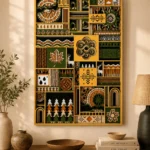
Multilayer wooden wall art looks simple from across the room – a picture carved in wood. Walk closer and you notice something different: the design is built from several thin layers stacked on top of each other, each one cut to a slightly different shape. That stacking is what gives the artwork real depth, soft shadows and a look that changes through the day. Here is how we make every piece at Embercut Studio, from the first sketch to the moment it arrives ready to hang on your wall.
1. It starts with a design built in layers
Every artwork begins as a drawing – a mandala, a Japanese landscape, a forest scene or a musical motif. Unlike a flat print, the design has to be planned in layers from the very beginning. The designer decides what sits at the back (the base and background), what sits in the middle, and which fine details rise to the top.
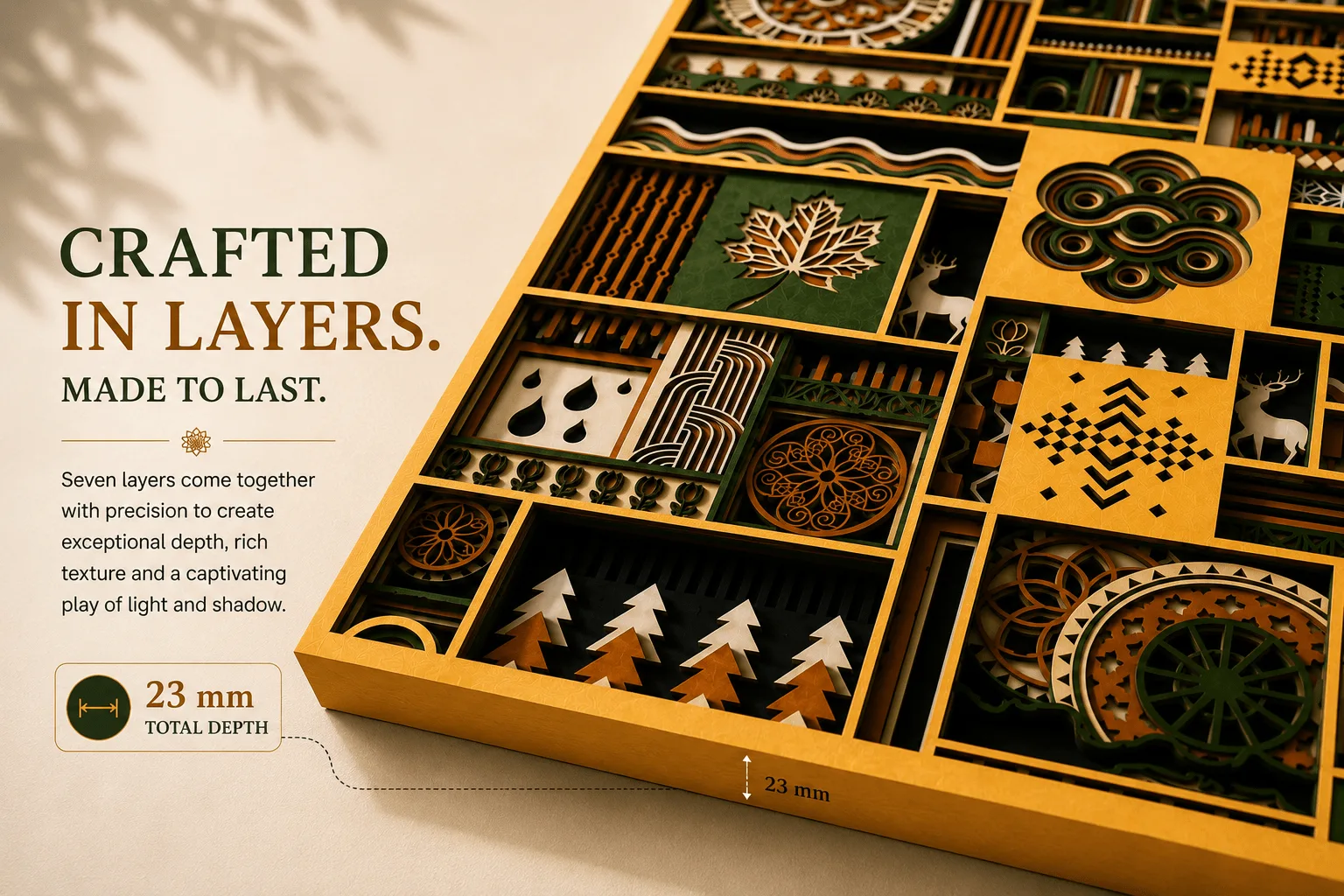
A piece like our 10-layer Paisley Mandala is split into ten separate outlines. Each layer is a little more open than the one below it, so when they are stacked the pattern appears to rise out of the wall. Fewer layers give a flatter, graphic look; more layers give deeper relief and stronger shadows.
2. Precision laser cutting
Once the layers are ready, each one is cut from premium engineered wood on a laser cutter in our workshop in Guntur, Andhra Pradesh. The laser follows the design with very fine accuracy, which is why thin petals, lattice work and tiny dots can be cut cleanly – details that would be almost impossible to cut by hand.
Engineered wood is chosen because it is stable and resists warping over time, which matters when several layers need to stay perfectly aligned for years.
3. Finishing and colour
After cutting, the layers are cleaned and finished. Depending on the design, layers are left in natural wood tones or painted by hand. The Saxophone Mandala, for example, is hand-painted in yellow, teal and blue so the instrument and musical notes pop against the pattern, while the Mount Fuji and Pagoda piece uses a calm palette of black, grey and white.
Top-layer edges are smoothed by hand. It is a small step, but it is what makes the finished piece feel premium when you touch it – and it is also why no two pieces are ever exactly identical.
4. Stacking and assembly
Next, the layers are stacked in order and bonded together. Alignment is everything here: if one layer shifts even slightly, the design looks blurred. Once bonded, the artwork becomes a single solid relief, anywhere from about 20 mm to 30 mm deep depending on the number of layers.
5. Ready to hang
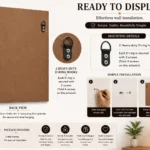
Every piece is sent out fully assembled. Heavy-duty D-ring hooks are fitted on the back, and wall screws and plugs are included in the box, so you can hang it the day it arrives. Want to do it yourself? Read our step-by-step guide on how to hang and care for wooden wall art.
6. Packed carefully and shipped free across India
Finally, each artwork is packed with protective padding in a sturdy box. Orders are dispatched within 6–7 days of being received and shipped free anywhere in India – see our Shipping Policy for details.
Why layered wall art feels different from a print
- Real depth: the layers cast soft shadows that move with the light through the day.
- Texture: you can see and feel the craftsmanship up close.
- Handmade character: hand finishing means small, natural variations that make each piece unique.
- Durability: engineered wood holds its shape and does not fade like paper prints.
Find your piece
Explore our full range of handcrafted multilayer wooden wall art, or if you have a design, size or quantity in mind, ask us about custom and bulk orders.